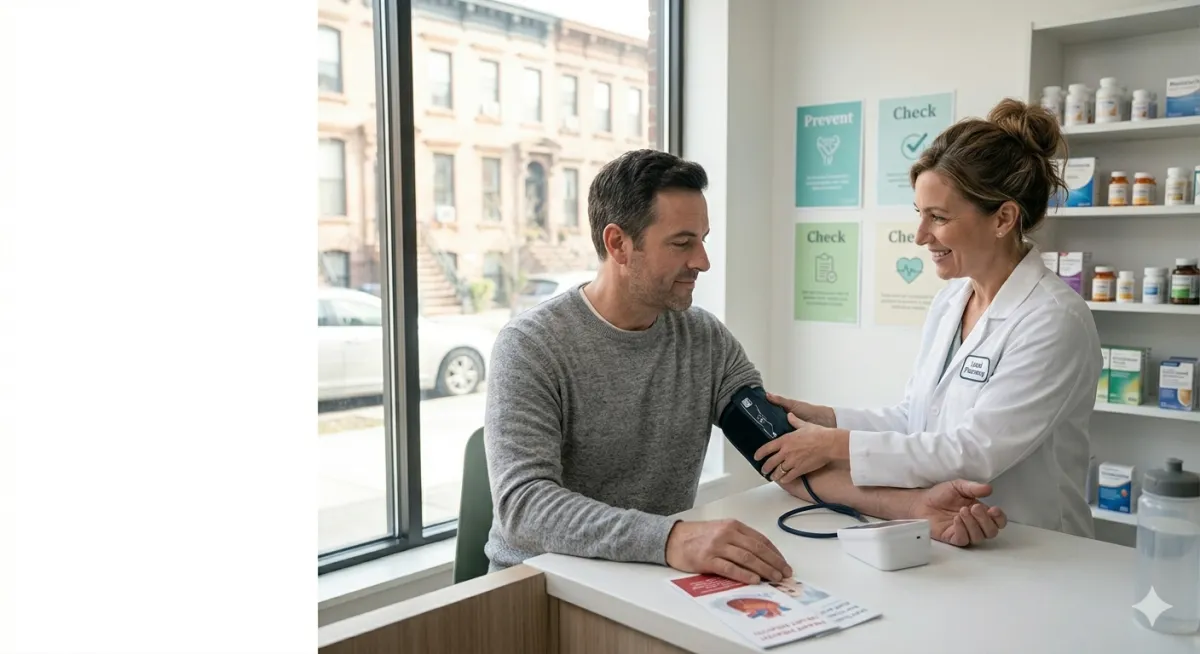
Managing High Blood Pressure: Local Screenings at Crescent Pharmacy
If I had to name one reason high blood pressure stays dangerous for so long, it would be this:
It usually does not make a big entrance.
That is exactly why it is called the “silent killer.” The CDC says high blood pressure typically has no signs or symptoms, yet it can still damage the heart, brain, kidneys, and eyes over time. It also defines high blood pressure as readings that are consistently at or above 130/80 mm Hg.
For a lot of people in Valley Stream, the problem is not that they do not care. It is that they do not want to make a full doctor’s appointment just to “check a number.” That is where local monitoring becomes practical. Crescent Pharmacy’s website specifically highlights Free Blood Pressure Monitoring, along with prescription transfers, refills, and neighborhood pharmacy care in Valley Stream.
So when I think about Blood pressure check Valley Stream, heart health NY, and preventative care, I do not think only about emergencies. I think about making it easier to catch a problem before it becomes one.
Why does blood pressure deserve attention even when I feel fine?
This is the hardest part for many people to accept.
If high blood pressure caused obvious pain every day, most people would check it sooner. But that is not how hypertension usually works. The CDC says it often has no symptoms at all, even while it increases the risk of serious complications.
The American Heart Association says the best way to know whether blood pressure is in a healthy range is to measure it, because you cannot reliably “feel” whether it is high. It also explains that:
normal is less than 120/80
elevated is 120–129 and less than 80
high blood pressure begins at 130/80
That means if I am avoiding a quick check because I feel okay, I may just be delaying useful information.
Why do people avoid monitoring in the first place?
A lot of people do not skip monitoring because they are irresponsible.
They skip it because it feels inconvenient, or because they assume one reading is not important, or because they do not want to hear bad news on a busy day. That is especially common for adults juggling work, kids, caregiving, or medication schedules.
But the AHA’s home-monitoring guidance makes a key point: even a single elevated reading is worth taking seriously enough to recheck and record. It says that if I get a higher-than-normal reading, I should take it again and write both results down.
That is why local screening matters. It lowers the barrier to getting started.
What can a simple blood pressure check actually do for me?
A quick screening does more than give me a number.
It helps me answer practical questions like:
Is my blood pressure in the normal range?
Has it moved into elevated or high territory?
Should I start checking more often?
Do I need to bring a record of readings to my doctor?
Is this something I have been ignoring for too long?
The AHA’s blood pressure guidance explains that elevated blood pressure can progress into hypertension if I do not take action, and that Stage 1 and Stage 2 hypertension usually require lifestyle changes and, depending on the case, medication.
So even a simple preventative care check can help me make better decisions earlier.
Why local pharmacy monitoring makes sense?
A neighborhood pharmacy is often the easiest place to stop guessing.
Crescent Pharmacy’s site specifically advertises Free Blood Pressure Monitoring, which is exactly the kind of service that helps people who want a practical first step without turning it into a whole hospital-style day.
That matters because the first step in managing blood pressure is often not treatment. It is awareness.
If I can get a quick local reading, I am more likely to:
know my baseline
spot a trend
stop minimizing the issue
ask smarter follow-up questions
For many people, that is the moment when “I should probably check that someday” becomes “I should start paying attention now.”
What do those numbers actually mean?
This is where blood pressure gets less scary once I understand it.
The American Heart Association says:
Normal: less than 120 systolic and less than 80 diastolic
Elevated: 120–129 systolic and less than 80 diastolic
Stage 1 hypertension: 130–139 systolic or 80–89 diastolic
Stage 2 hypertension: 140 or higher systolic or 90 or higher diastolic
Severe hypertension: higher than 180 and/or higher than 120
That is important because people often hear “my pressure was a little high” without knowing whether that means mildly elevated or something more serious.
If my reading is unexpectedly high, that does not always mean instant panic. The AHA says a single high reading is not automatically an emergency and should usually be rechecked. But if readings stay above 180/120, especially with symptoms like chest pain, shortness of breath, weakness, or vision changes, I should seek urgent care.
Why home monitoring may be the next smart move?
Sometimes, the best follow-up to a pharmacy screening is better tracking at home.
The AHA says home monitoring can help people and their healthcare teams understand whether blood pressure is consistently elevated rather than relying on one isolated reading. It also recommends writing down readings and discussing them with a healthcare professional.
That is especially useful if:
my first reading is borderline or elevated
I feel nervous in medical settings
I want to track patterns over time
I am already on blood pressure medication
my doctor wants more consistent data
So if I get a reading at Crescent Pharmacy that makes me pause, home monitoring may be the natural next step.
Counseling matters just as much as the reading
A number alone is helpful. A number with an explanation is much better.
If I got a reading at a local pharmacy, I would probably want answers to questions like:
Is this a one-off reading or something I should follow up on?
Should I recheck it again later today or this week?
At what point do I call my doctor?
What habits are most likely making this worse?
If I already take medication, could something need to be reviewed?
That is why a neighborhood pharmacy setting can be so useful. Crescent Pharmacy’s recent blog content on medication safety shows that the pharmacy already positions itself as a place where patients can get help thinking through medication-related risks and chronic-care concerns, not just a place to pick up bottles.
A natural internal next step here is the pharmacy’s broader site content and service pages, where patients can explore refills, med sync, and other support tied to ongoing medication management.
Why does this matter for heart health in New York?
High blood pressure is not an isolated issue. The CDC says it is a major risk factor for heart disease and stroke, two of the leading causes of death in the United States.
That is why heart health NY is not just a hospital topic. It is a neighborhood topic.
If I can catch blood pressure issues earlier through local screening, that can help me move toward:
better follow-up
more accurate monitoring
smarter medication use
more consistent lifestyle changes
That is what preventative care is supposed to do.
Final thoughts
High blood pressure is dangerous partly because it is easy to ignore.
The CDC says it usually has no signs or symptoms, and the AHA says the best way to know where I stand is to get it checked.
That is exactly why simple, local screening matters. If I want to take Blood pressure check Valley Stream, heart health NY, and preventative care seriously, I do not need to wait until something feels wrong. I can start by knowing my numbers.
And because Crescent Pharmacy specifically offers Free Blood Pressure Monitoring right in Valley Stream, it gives local residents a practical place to start paying attention before the problem gets bigger.
